
Engineering at Capmo
The last big industry without an AI layer.
Construction is around 10% of Europe's GDP and still runs on pen, paper and WhatsApp. Every other industry has AI companies fighting over it. This one has us — and the data.
01
The industry is enormous and undigitised.
Ten percent of GDP, and the coordination still happens in email threads, printed plans and site huddles. Not "ripe for disruption" — genuinely unbuilt. The gap between what the industry needs and what exists is the largest we know of.
02
We're already the system of record.
Capmo runs construction execution across D-A-CH: defects, tasks, schedules, plans, protocols, contracts. AI in this industry has to run on the record of what actually happened on site, and that record is ours.
03
Ten years of the messiest data you'll ever see.
Millions of files and records: the same entity under five names, facts true in March and false in June, decisions buried three replies deep in a thread, drawings at revision 7 while site reality is at revision 8. This is the input. It's also the hard part.
What's next
Capmo Brain: a memory substrate for construction projects
We're building AI construction-site management — KI-Bauleiter — but agents on their own aren't the interesting part. The layer underneath is: a shared memory substrate that watches, compresses and organises everything that happens across tens of thousands of projects — documents, defects, tasks, schedules, meetings, plans, contracts, email — so agents don't rebuild the project from scratch on every query. We're building it in-house.
Three reasons it's hard
01
Every agent starts from zero.
Search, change-order validation, meeting prep, dictation — each one re-reads the project on every query, re-fights the same duplicates and contradictions, and shares nothing it learns. The insight surfaced during a Nachtragsprüfung evaporates the moment the response renders.
02
The data is messy, contradictory and bi-temporal.
A decade of emails, drawings, RFIs, minutes and change orders. Entity resolution, provenance on every claim, and knowing when something was true versus when it was recorded is the actual work. Vector search alone doesn't touch it.
03
Nothing compounds.
Every project team relearns the same lessons; knowledge leaves with people or gets buried in PDFs. Without a substrate that captures what actually happened — episodic, semantic, procedural — there's no memory to build on, and no moat a frontier model can't erase overnight.
Brain is the layer that turns millions of records into memory agents can trust: bi-temporal fact stores, entity resolution, graph and vector storage, and evals that prefer "information is missing" over a confident guess. It's the work of a small, very senior team, and it's the part of our roadmap we're least sure of and most interested in.
Who you'd work with
Small team, high leverage, no hiding
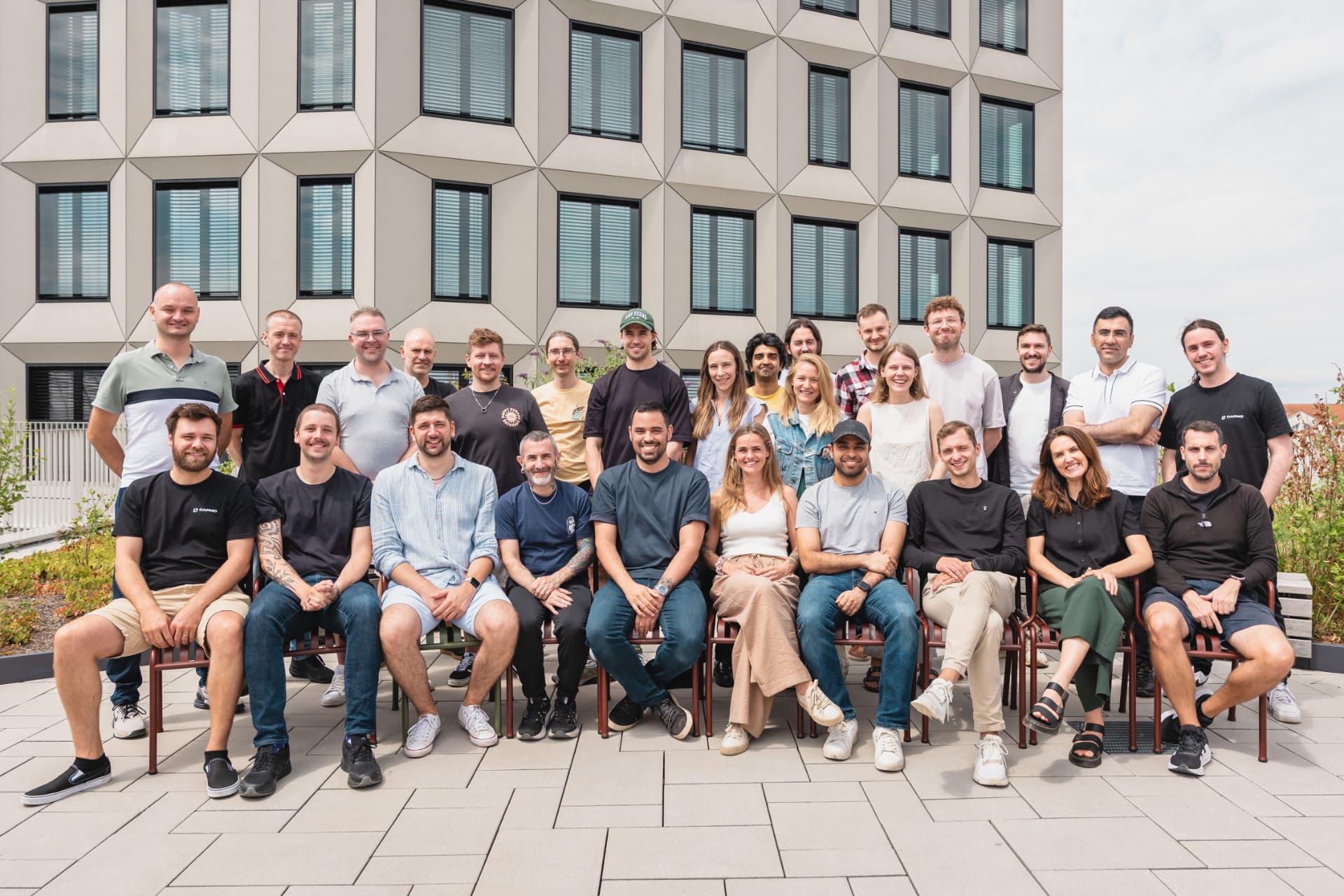
Around 30 engineers across Munich, Berlin and remote. Average tenure close to three years; several people approaching seven. In a market where two years is a long stint, people stay because the work stays interesting.
How we work with agents
Every engineer here works with coding agents daily. That part isn't interesting anymore, everyone does it. What's interesting are the second-order problems: review moved upstream, accountability that didn't move, and change failure rate as a first-class metric.
How we work with agents →Senior engineers who'd rather inherit a hard problem than start a clean one.
Roles in Munich and Berlin, hybrid. English is the working language; the domain is stubbornly German. We're hiring on two tracks.
Track 01
Software engineers
Product and platform work on the system of record, and the memory substrate agents run on.
Who we're hiring →Track 02
Security engineers
Putting agents on that record changes the threat model. We want defenders who own that and build the harnesses that attack it before anyone else.
Security engineering at Capmo →